

This section of the Timbre and Orchestration Resource contains links to analytical research from ACTOR Project members and as well as to recommended external content. Here you will find new tools and perspectives for analyzing orchestration and timbre, links to analytical resources, and more. The topics and links are organized into three main categories: Resources, Repertoire, and Recordings
The topics and links are organized into three main categories:
Resources | Research | Repertoire.

RESOURCES
Resources for analysis of orchestration and timbre, including softwares, publications, theory, toolboxes, and external links.
Tools
Tools for music analysis based on orchestration and timbre.


Databases and Compendia
Databases and Compendia of music analyses based on orchestration and/or timbre.

RESEARCH
Ongoing research on orchestration and timbre analysis.
Active Projects and Working Groups
Software development, tools for music theory and multidisciplinary research on timbre and orchestration.


Scholarly publications
Scientific papers and publications about research on orchestration and timbre analysis.

This dissertation examines the role of timbre in musical interpretation, focusing on its contribution to expression and perception. Using an analysis-synthesis approach, it offers new insights into how performers shape sound beyond timing and dynamics.


Visit Site >
Hansen, N. C., & Huron, D. (2018). The lone instrument: musical solos and sadness-related features. Music Perception: An Interdisciplinary Journal, 35(5), 540-560.

Visit Site >
Chon, S. H., Huron, D., & DeVlieger, D. (2018). An exploratory study of Western orchestration: Patterns through history. Empirical Musicology Review, 12(3-4), 116-159.

Visit Site >
Sallis, F., Bertolani, V., Burleis, J., & Zattra, L. (2020). Live Electronic Music. Routledge.

Visit Site >
Wollman, I., Arias, P., Aucouturier, J. J., & Morillon, B. (2020). Neural entrainment to music is sensitive to melodic spectral complexity. Journal of Neurophysiology, 123(3), 1063-1071.

Visit Site >
Saitis, C., Weinzierl, S., von Kriegstein, K., Ystad, S., & Cuskley, C. (2020). Timbre semantics through the lens of crossmodal correspondences: A new way of asking old questions. Acoustical Science and Technology, 41(1), 365-368.

Visit Site >
Esling, P., Masuda, N., Bardet, A., Despres, R., & Chemla-Romeu-Santos, A. (2020). Flow synthesizer: Universal audio synthesizer control with normalizing flows. Applied Sciences, 10(1), 302.
Visit Site >
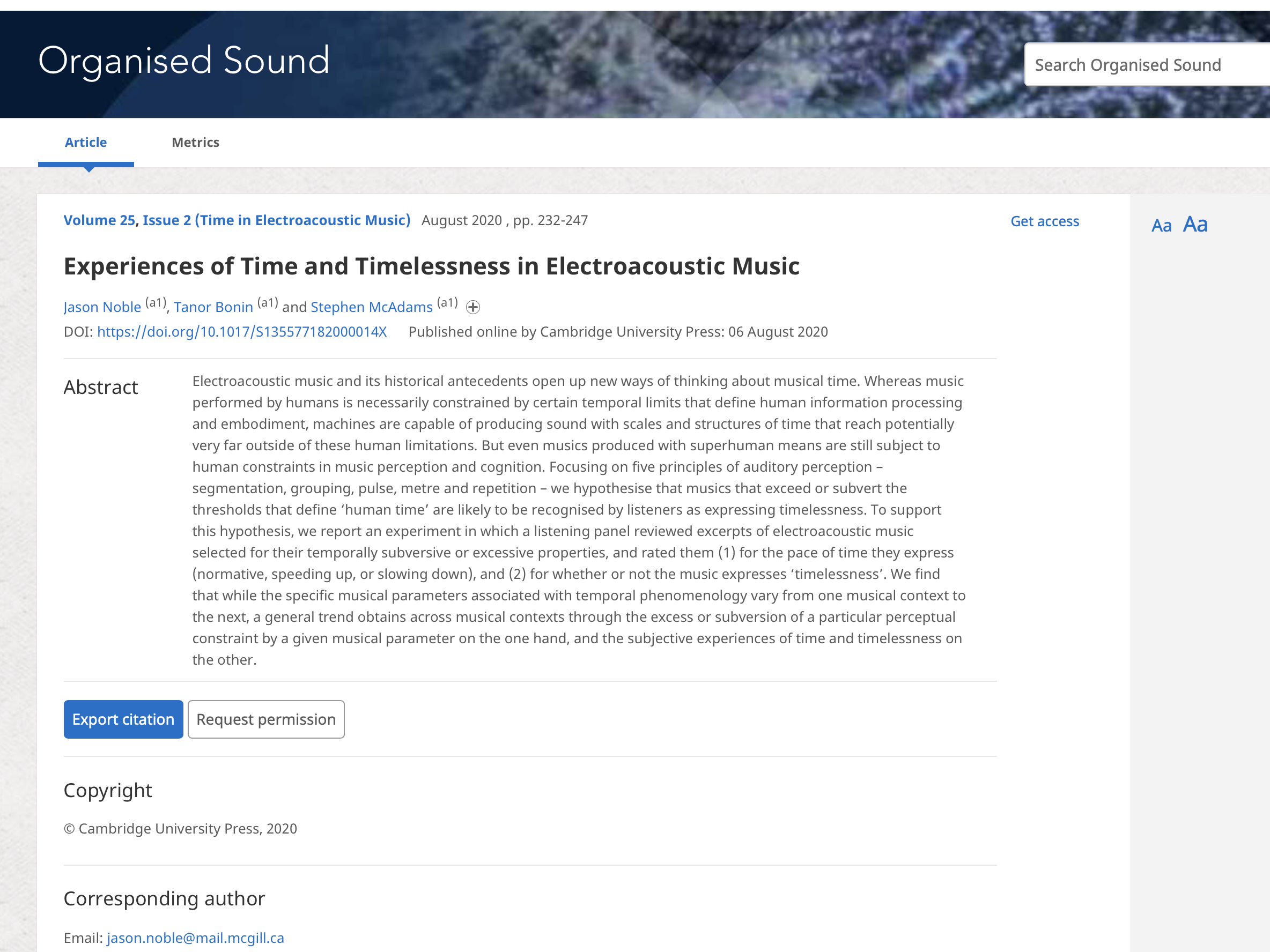
Noble, J., Bonin, T., & McAdams, S. (2020). Experiences of Time and Timelessness in Electroacoustic Music. Organised Sound, 25(2), 232-247.

Visit Site >
Noble, J., & McAdams, S. (2020). Sound mass, auditory perception, and ‘post-tone’music. Journal of New Music Research, 49(3), 231-251.

Visit Site >
Wallmark, Z., & Allen, S. E. (2020). Preschoolers’ crossmodal mappings of timbre. Attention, Perception, & Psychophysics, 1-7.



Web-based media
Web-based media: talks, conference presentations, and workshop in video or web format.
This dissertation examines the role of timbre in musical interpretation, focusing on its contribution to expression and perception. Using an analysis-synthesis approach, it offers new insights into how performers shape sound beyond timing and dynamics.

Visit Site >
Orchestration Analysis Series — Introduction
Debussy's Oceanic Orchestra: La mer
Visit Site >
Hansen, N. C., & Huron, D. (2018). The lone instrument: musical solos and sadness-related features. Music Perception: An Interdisciplinary Journal, 35(5), 540-560.
Visit Site >
Chon, S. H., Huron, D., & DeVlieger, D. (2018). An exploratory study of Western orchestration: Patterns through history. Empirical Musicology Review, 12(3-4), 116-159.
Visit Site >
Sallis, F., Bertolani, V., Burleis, J., & Zattra, L. (2020). Live Electronic Music. Routledge.
Visit Site >
Wollman, I., Arias, P., Aucouturier, J. J., & Morillon, B. (2020). Neural entrainment to music is sensitive to melodic spectral complexity. Journal of Neurophysiology, 123(3), 1063-1071.
Visit Site >
Saitis, C., Weinzierl, S., von Kriegstein, K., Ystad, S., & Cuskley, C. (2020). Timbre semantics through the lens of crossmodal correspondences: A new way of asking old questions. Acoustical Science and Technology, 41(1), 365-368.
Visit Site >
Esling, P., Masuda, N., Bardet, A., Despres, R., & Chemla-Romeu-Santos, A. (2020). Flow synthesizer: Universal audio synthesizer control with normalizing flows. Applied Sciences, 10(1), 302.
Visit Site >
Noble, J., Bonin, T., & McAdams, S. (2020). Experiences of Time and Timelessness in Electroacoustic Music. Organised Sound, 25(2), 232-247.
Visit Site >
Noble, J., & McAdams, S. (2020). Sound mass, auditory perception, and ‘post-tone’music. Journal of New Music Research, 49(3), 231-251.
Visit Site >
Wallmark, Z., & Allen, S. E. (2020). Preschoolers’ crossmodal mappings of timbre. Attention, Perception, & Psychophysics, 1-7.



REPERTOIRE
Research works based on specific works or types or repertoire.
Analytical applications
Examples of application of analytical tools.

Scores
Examples of visual representation of analysis works on diagrams and/or scores.
Recordings
Analysis works on timbre and/or orchestration based on recordings.
Visit Site >