
Symposiums and Workshops
Video Series | Analysis, Creation, and Teaching of Orchestration Symposiums and Workshops
Analysis, Creation, and Teaching of Orchestration
Symposiums and Workshops
The ACTOR Project hosts annual workshops and bi-annual symposiums on various research projects taking place in the partnership.
This page is a repository of the videos from these events.
Amit Gur (Antwerp University) — Form and Material in Visual and Auditory Perception
Benjamin Lavastre (McGill University) — Orchestration and timbre writing challenges in mixed music with digital musical instruments: Case study of Instrumental Interaction V for 3 Karlax and ensemble
Kelsey Lussier (McGill University) — Identifying Orchestrational Norms and Trends in Funk Grooves
Jonas Régnier (McGill University) — Everyday Sounds as Emotional Catalysts: A Research-Creation Study in Contemporary Music
Joshua Rosner (McGill University) — To Be or Not to Bop: How Phonetics and Timbre Shape Rhythm and Phrase in Scat Singing
Shanghai Nights: The Cultural Politics of Vocal Timbre in Chinese Popular Music, 1930–49 | Annie Liu (University of Oregon)
An experimental framework for computer assisted orchestration | Francesco Maccarini (Université de Lille)
Intersections of Timbre and Structure in Nigerian Music: A Case Study of Akwu-eche-enyi | Chidi Obijiaku (University of Witwatersrand)
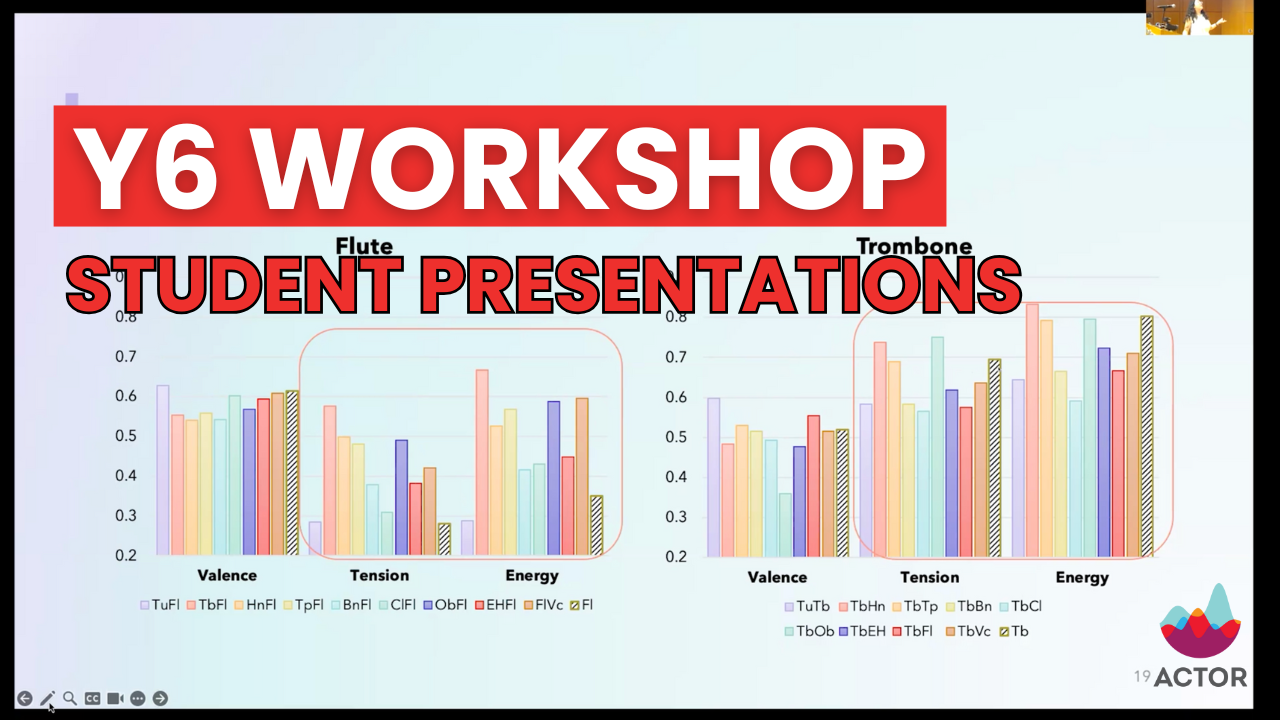
Affective Qualities of Sustained Instrumental Blend | Yifan Huang (McGill University)
The role of timbre in source identification in atypically combined excitations and resonators of musical instruments | Erica Huynh (McGill University)
Instrument identification and blend in virtual acoustic scenes - a case study of the Tristan prelude | Simon Jacobsen (University of Oldenburg)
Choreographing Orchestration: A Novel Method for Analyzing Orchestration through Ballet | Rebecca Moranis (CUNY Graduate Center)
The Voices of Ancestors: Vocal Timbre Descriptors in Zambian Luvale Makishi Masquerade | Jason Winikoff (UBC)
Comparison of perceived and imagined instrumental blend | Linglan Zhu (McGill University)
Timbre perceptions of vocal vibrato | Theodora Nestorova (McGill University)
Deep audio learning for novel timbre generation | Ninon Devis (IRCAM)
Did Messiaen draw from shared crossmodal correspondences within his synesthetic colour system? | Chelsea Komschlies (McGill University)
Principles of Gestalt psychology as a means for emergent orchestration | Ehsan Fard (Hochschule für Musik und Theater Felix Mendelssohn)
Compound figures in my CORE piece "Étude for ensemble" | Louis-Michel Tougas (McGill University)

The blending between sound sources in a joint performance is an important feature relevant in the evaluation and reconstruction of the sound field of an orchestra/ensemble in real life and also in virtual reality domain. I

La recherche est generalement recentrée sur les strategies d'integration et d'adaptation des elements ésthetiques des modes particulieres du Moyen-Orient vers un langage contemporaine occidentale.


There are several key attributes designated by sound experts to characterize timbre. Their use is common but varies greatly depending on the professional field.

Current timbre research has focused overwhelmingly on what George Lewis (1996) describes as Eurological traditions; musical traditions that are based in European-derived beliefs, behaviors, and logics.

Bright (brillant), round (rond), warm (chaud) and rough (rugueux) are four terms vastly used in French language for sound description in sound creation processes such as music performance, orchestration, sound engineering or sound design, yet they lack formal, standardized definitions.

The impression of ensemble sound and blending between musical instruments is an important feature relevant in music composition, orchestration, stage acoustics adaption, and virtual acoustics.

The impression of ensemble sound and blending between musical instruments is an important feature relevant in music composition, orchestration, stage acoustics adaption, and virtual acoustics. Within a larger project, we perform research on musical instruments and the effect of blending.

I will demonstrate how timbre and auditory scene analysis act as a central element in the emergence of musical form in a contemporary aleatoric composition with open instrumentation: all voices are heard (2015) by James Saunders.

Composers for film and video games generally make use of digital audio workstations (Pro Tools, Cubase, etc.) to complete their work. Sample libraries, virtual instruments, and extensive programming in their chosen software allow them to produce realistic sounding mock-ups that serve either as placeholders until their music has been recorded or, in some cases, as the final product itself.
