
Que reste-t-il? -Hindewhu Extinction-
photo credit: Alberto Novelli / Villa Massimo, 2025
This interview took place as an online video call a few weeks before the premiere of Fabien Lévy’s Que reste-t-il: Hindewhu Extinction. The transcript has been edited for concision and ease of reading. The new work will be performed at the Donaueschinger Musiktage 2026 by the SWR Symphonieorchester directed by François-Xavier Roth on October 18, 2026 at 17:00 CEST, and will be broadcast as a livestream. The composer’s program note on the piece can be found online.
Robert Hasegawa (RH)
Maybe we could start with the title of the piece, which has two parts: “Que reste-t-il” (“what remains”) and “Hindewhu Extinction.” I know you've written recently about Hindewhu—a hocketing musical practice for voice and a single-pitch reed flute practiced by the Ba-Benzélé (Aka) people of central Africa—in your article “L’artiste, entre production et destruction.” There you discuss the “Hindewhu ideal,” with its astonishing complexity achieved through simple means, as a possible remedy for the hierarchization and overconsumption that characterize Western music making in the Anthropocene. I'd be curious to hear more about Hindewhu and its relation to the orchestra piece.
Fabien Lévy (FL)
The Hindewhu repertoire is something which has interested me for a long time. In fact, the Hindewhu repertoire is now pretty well known because it was written about by ethnomusicologist Simha Arom and imitated famously by Herbie Hancock in the introduction to “Watermelon Man.” There’s an ethnomusicologist, Steven Feld, who’s written about it too, it's quite interesting.
Even before I learned about Hindewhu, my music was already pointillist, it was about games of contradiction between separate identities and the whole, very paradoxical and textural. One of my important first pieces was a saxophone quartet [Durch, in memoriam Gérard Grisey, 1998] and I said to myself: “I have four instruments—I will do everything I can so that we don't hear four voices.” So it's all about pointillism, mosaics, paradoxical textures, and creating virtual intruments instead of those real four.
But of course, when I discovered the music of the Aka, I was really struck and then later I became a very close friend of Simha Arom. The Hindewhu repertoire, a solo piece sung by a woman or a man alone, is particularly interesting because it's more than only hocketing. This repertoire combines the voice with one of the simplest and smallest instruments, the Hindewhu, a very simple papaya twig, playing only one note. Even though only one person is singing, you hear three voices. the yodeling voice in two registers plus the instrument itself. And furthermore, as Simha Arom’s seminal analysis showed, even though there’s only one instrumentalist singing and playing, they obtain a quite incredible complex polyrhythm because the sung part is in seven plus five, and every four you have a rest: it's mathematically very, very complex! And this is in a culture where you have no conservatories, no professional experts for music, where everybody sings. The simplicity of the elements versus the complexity of the whole, the mathematical and sonic subtlety have always struck me as extraordinary, and this repertoire, it seems to me, is part of humanity's intangible cultural heritage, along with Beethoven or Bach. Now it’s in my world, I play with that.
RH
What I think of as central to your pieces is texture, first of all. I also think of pointillism (as you mentioned) and illusion. I notice that you like to create effects that are emergent, that only arise when smaller, simpler parts are combined.
FL
Exactly. The piece is full of textures, which my numerous exchanges with ACTOR members have helped me to better understand and define as “coupled elements perceived as one merging element, without perception of concurrent segregation between layers or sequential contrasts.” There are numerous homogeneous textures, even more heterogeneous textures (which are much more difficult to make perceived as one element and require particular merging strategies), and also paradoxical textures, where the internal movement of the agitation is different from the overall direction of the transforming texture. The beginning of the piece, for instance, is full of heterogeneous, paradoxical textures." In this piece, you will also hear numerous textures—couplings—that take on distinctive timbres because half the orchestra is detuned a quartertone lower. I also create textures using acoustic phenomena—Doppler effects, mosaic-like microtonal glissandi, etc.—that are quite unusual for a purely acoustic orchestra.
More generally, I could perhaps summarize many of my pieces like the children’s game where you pat your head and rub your belly then have to switch. When I wrote my first saxophone quartet, there are four instruments and a lot of hocketing between the voices, creating what I call “virtual instruments.” When I wrote one of my first orchestral pieces, for viola and orchestra [Hérédo-ribotes, 2001], I didn't yet know about Hindewhu or Aka music but already was exploring related ideas. They asked me for a concerto, which is against my kind of musical thinking. But what I did, I made the viola play as if it’s ten or twelve different instruments, while it’s also part of the ensemble. The subtitle of that concerto is “for solo viola and 51 orchestra musicians”—so it means everything is divisi and you have a lot of complexity. In the concerto, even though I didn't yet know the Hindewhu, I was thinking about what I would set in opposition to the solo viola—I had already started the deconstruction of Western instruments which happens in much of my music—and I decided to use a PVC tube played by a flutist at the back of the orchestra as a musical—but also sociological—contrast to the soloist's expensive viola.
These ideas are a big part of my musical language. In that sense, Hindewhu is symbolic of many of my interests.
RH
So it's not “Hindewhu Extinction” in the sense of the extinction of Hindewhu specifically. It’s about the extinction of everything human?
FL
Yes. Another important aspect to understanding this piece goes beyond the music. As you know, for the past six or seven years I have been really struck by the climate crisis. It’s not my first piece about this existential crisis for everyone. But this piece and its the title “Hindewhu Extinction” is also related to the disappearance of this musical treasure and its performers, even though it was we—and not them—who caused this crisis. The forest where they live is being completely destroyed by commercial groups harvesting wood. “Extinction” is also meant here in relation to Extinction Rebellion, the activist movement.
We can certainly be afraid about this crisis, about our egoism, and about, in a way, the end of history, about what will remain of us, from us. I am not religious, but sometimes I hope if God were to exist, he would see that humans don’t only have bad things, they have Beethoven and the Hindewhu. That’s the other part of the title, “Que reste-t-il” (“what remains”). As I said before, the scordatura is really difficult for a normal orchestra because half of the musicians are detuned by a quartertone. So my idea, if it works, is perhaps to write other pieces in a cycle, always with the title “what remains,” followed by different subtitles.
RH
Let me ask you about a few specifically orchestrational things. You mentioned the microtonal retuning of certain instruments, and it's a really fascinating setup with half the winds tuned a quartertone lower than the rest of the orchestra. There are also microtonal retunings for the electronic keyboard, second violins, and some of the harp’s strings—and recalling the sound world of Hindewhu, five tubular flutes made of PVC piping and tuned to a kind of microtonal scale which are played by certain orchestra musicians.
One thing I noticed is that the detuned winds are grouped together in the stage layout (Figure 1) so that they’re physically separated from the normally tuned ones.Could you talk a little bit about that decision?
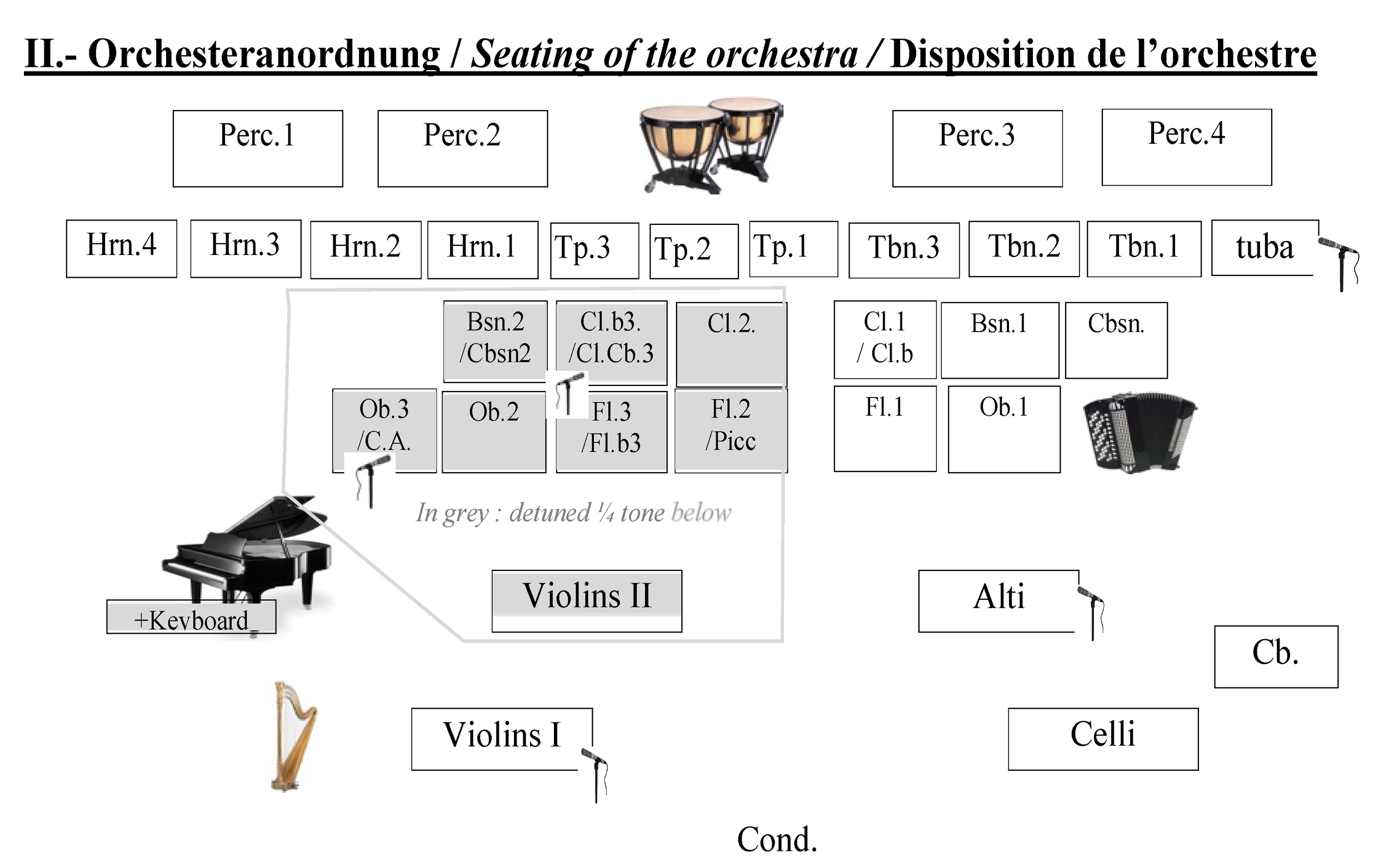
Figure 1. Excerpt from the preface to the score of Que reste-t-il: Hindewhu Extinction.
FL
Sure. Even with their detuned instruments, the tuning for the winds is difficult, the instrument can be less stable. So that's why I put them all together, because they play something like half of the pitches of my harmonic field. They have the same pitches as each other and are not so far from the second violins. As you know, the violins normally play by ear. So in this piece, the detuned second violins (also a quartertone lower than normal) only ever play open strings or natural harmonics to make sure that they play the correct intonation. [Note added on October 6: After the first few rehearsals, the orchestra decided to maintain its usual seating arrangement for practical reasons related to set changes, so the detuned instruments sit alongside those tuned to the first oboe’s A. The SWR Orchestra, however, manages to play this microtonal score without too much difficulty.]
It's very difficult to write in quartertones for orchestra. It's not my first piece where I detune half of the winds, and it works. It's easier for people who don't have absolute pitch. My music needs this sort of microtonality, because I’ve used my own harmonic technique for forty years, working with OpenMusic [software developed by IRCAM for computer-aided composition], et cetera. It’s not the spectral technique of Grisey or of Murail, It's my own spectral technique with prime numbers and pitch-screening techniques. I use it in all my music. And here I needed the same kinds of harmony, and that's why I needed this quartertone tuning.
A second thing that’s new in this piece is something I discovered in an organ piece I wrote in 2024 [Jusqu’à peu], a quite particular organ piece, for an organ in Germany that is very well known. It's a big quartertone church organ in the Kassel Cathedral. You can also control the pressure and a lot of other things. I spent a few nights on the organ and I discovered some effects through this practice. For instance, I had the idea (returning to an idea we discussed in ACTOR that comes from Marc-André Dalbavie) to use a change from directional sounds to non-directional ones (Figure 2). It starts with harmonica, trombones, which are very directional, then goes to the less directional flute and clarinet stops. The fifth E-flat-B-flat is repeated and moves through different timbres. The lower staves with a written D and A sound a quartertone higher than written, so the effect is a microtonal shift down by a quartertone.
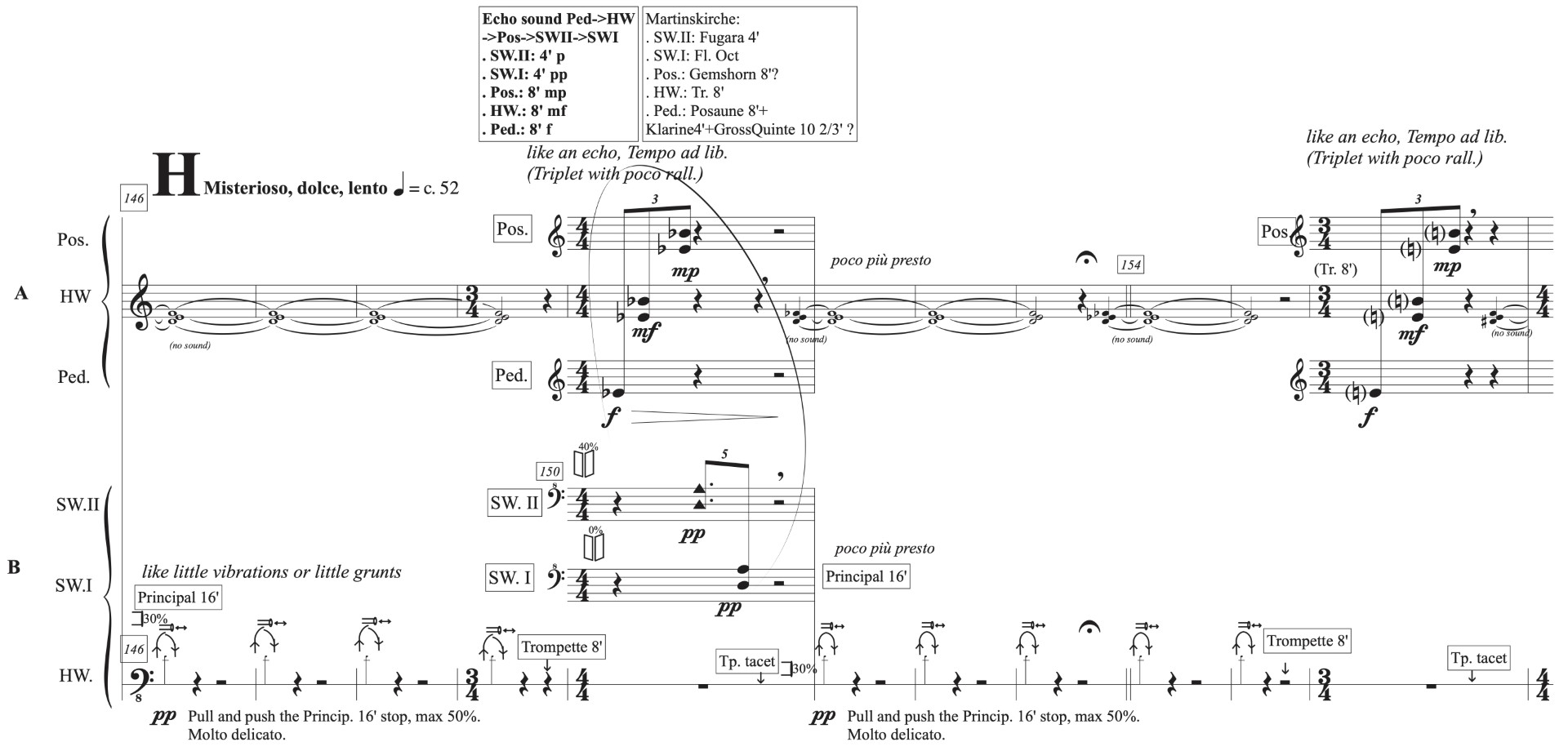
Figure 2. Excerpt from Jusqu’à peu for organ, measures 146–156. Click here for audio
RH
It really is very effective in creating a kind of Doppler effect!
FL
Yes, exactly, a sort of Doppler effect. It's very simple, but with the resonance of the church, it mixes, so you don’t hear the separate attacks so much. Listeners told me that they had the feeling the church became three or four times bigger at that moment because the spatial dimension was opened up.
But I thought, okay, for the orchestral piece, I will do something similar using my principle of directional to non-directional. But I will do a more complex texture, a long paradoxical texture. It’s a glissando. You can see this in measure 302 of the score, summarized in this sketch (Figure 3).
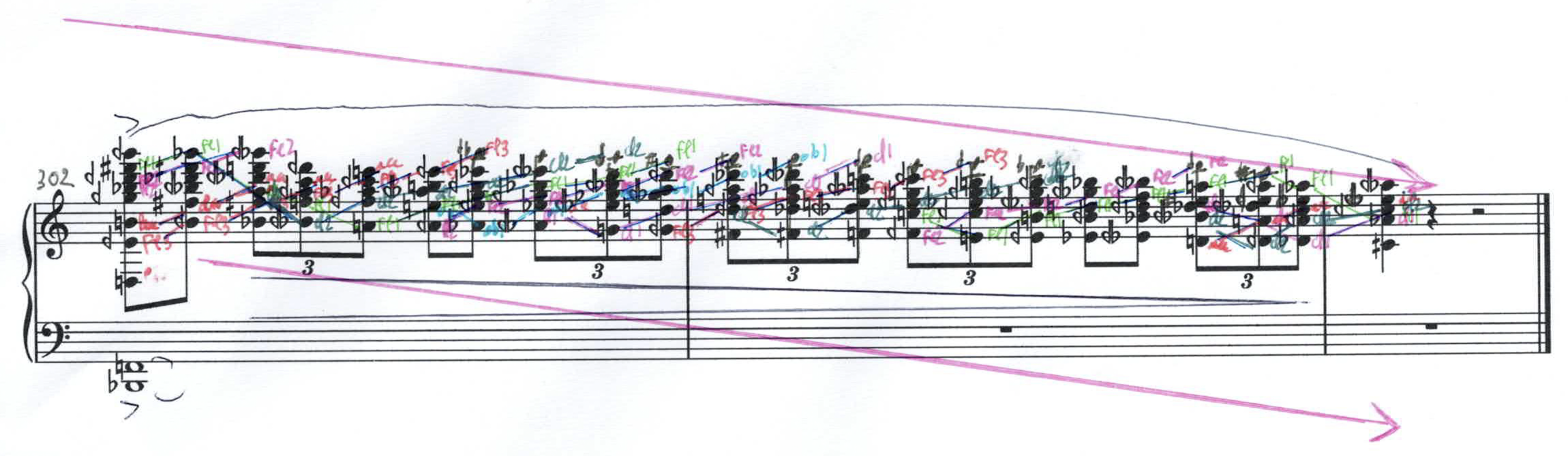
Figure 3. Sketch for a microtonally descending texture with paradoxical contrary motion in the the orchestral parts, Que reste-t-il: Hindewhu Extinction, measures 302–304.
It's a big chord, going down slowly, very simple. But the movements of the instruments don't simply descend, they move around in leaps and arpeggios crossing between voices of the chord. But at speed, I hope you will hear the pointillism and also the descending quartertone chords. You can see this strategy in many of my sketches—in the next sketch image (Figure 4), the lower staff includes the detuned wind instruments so sounds a quartertone lower. There is a continual quartertone descent but also lines that move up through the texture from chord to chord.
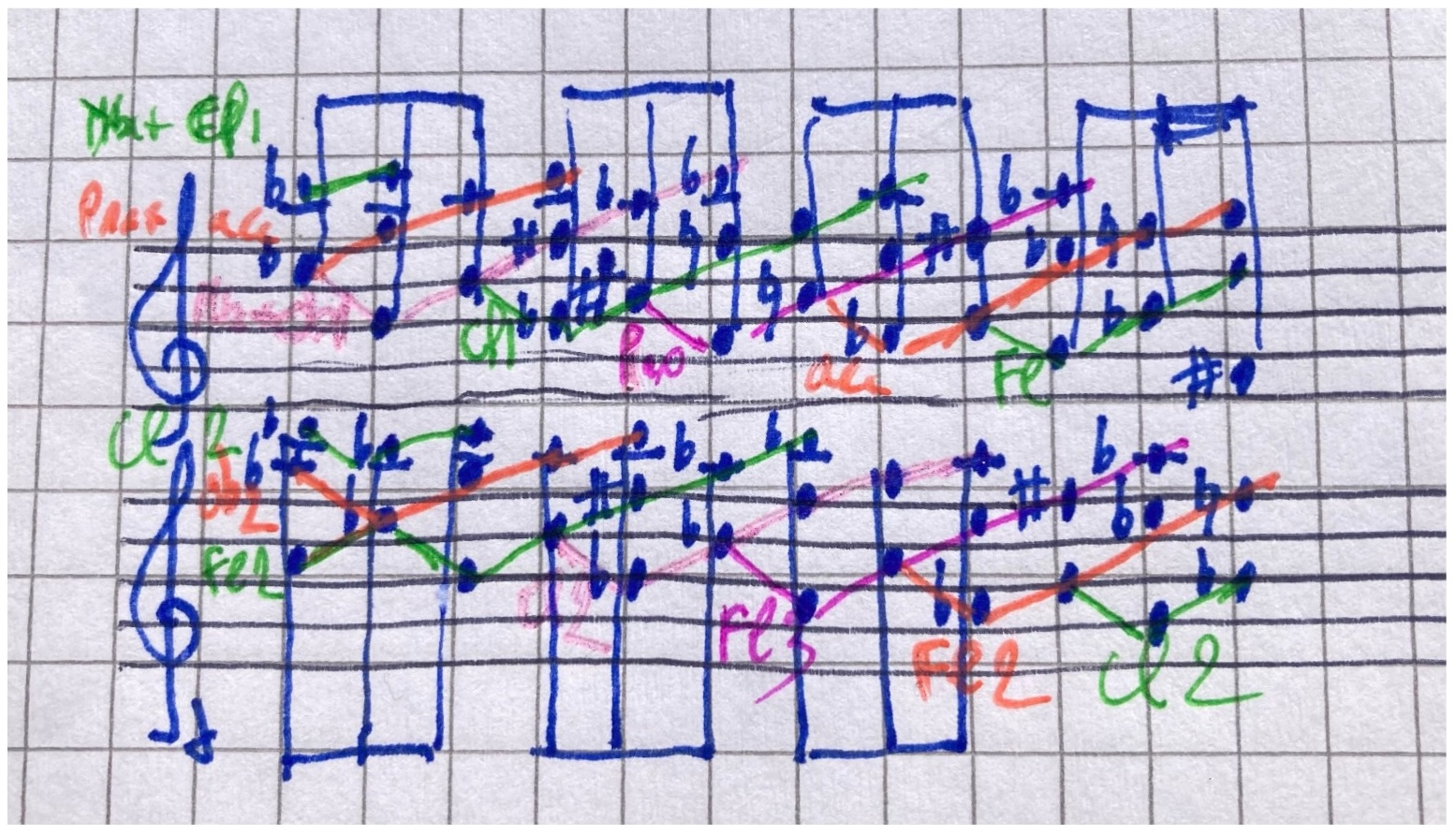
Figure 4. Sketch for a similar texture combining overall microtonal descent with ascending leaps in each instrumental part.
At E (measure 65), you’ll see there the indication “comme un effet Doppler.” This is one of the first times we hear this effect, it’s a short one. I orchestrate the winds with percussion, the detuned harp, the gong, detuned electric keyboard and the xylophone.
On page 23, mm167–173, there’s a different approach to creating this Doppler effect in the strings. Here it’s a sort of texture with a crescendo and decrescendo. The detuned second violins stay on the same pitches of their open strings, but the first violins, violas, and cellos slide down the fingerboard by a semitone, passing through a microtonal glissando at the peak of the crescendo (Figure 5). The detuned harp plays here too with a lot of quartertones, which sounds really strange on the harps—there’s also the piano, vibraphone, and waterphone with a superball mallet. The trumpets are orchestrated with the string glissando, using their tuning slides.
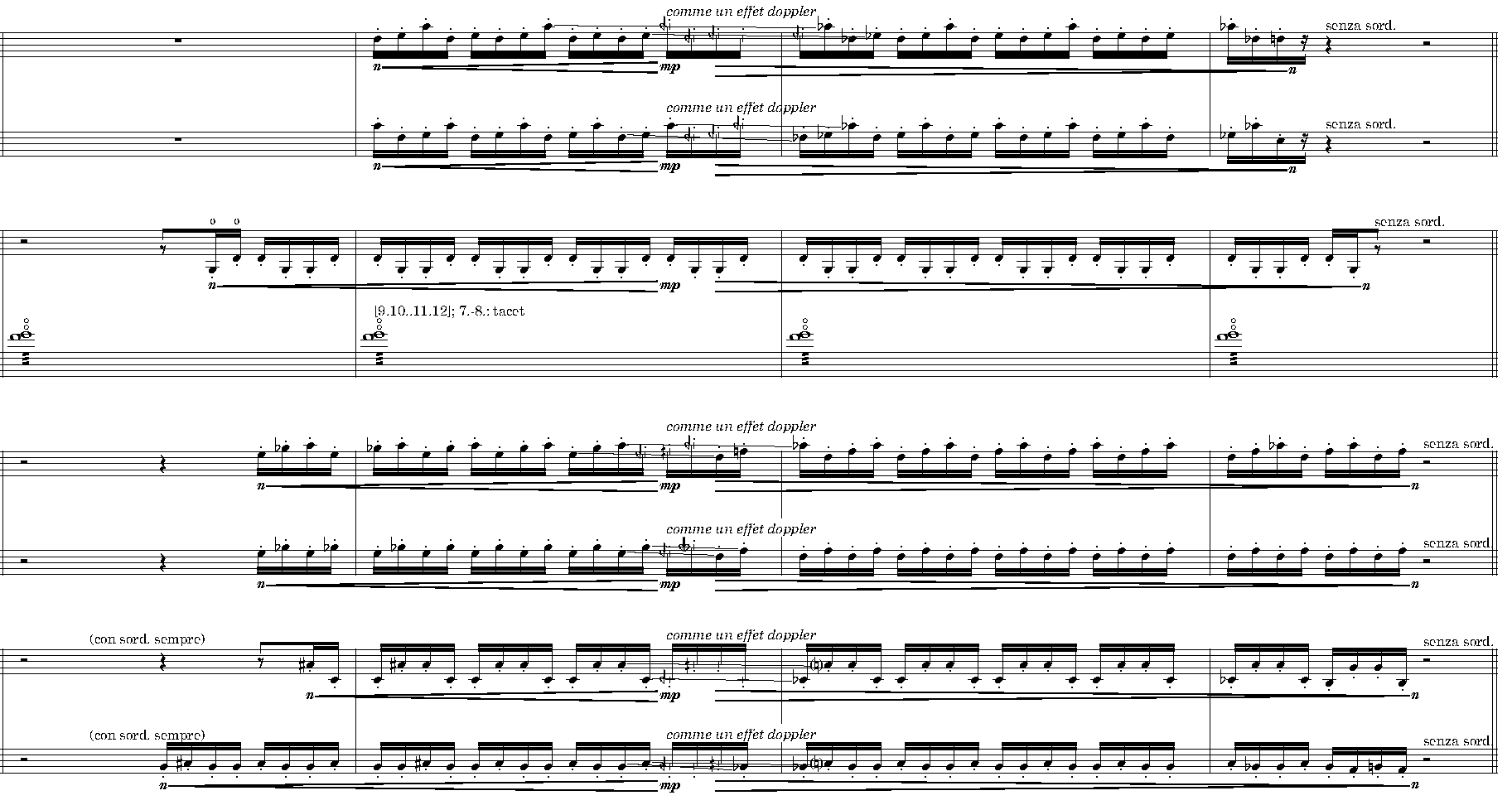
Figure 5. Doppler effect in the strings, measures 170–73.
RH
I was intrigued by the poetics of all the Doppler effects, because in a way, of course, the descent in pitch is the sound of something going away from us, right? It seems like that goes very well with the overall idea of extinction, or things disappearing.
FL
It's interesting that you say that, because as you perhaps know, I knew Jean-Claude Risset very well. I wrote an analysis of Mutations (1969), which includes of course his famous paradoxical glissando without end, which he first used in the piece Computer Suite for Little Boy (1968), which refers to the code name of the atomic bomb that, in Pierre Halet’s play, falls endlessly towards Hiroshima.
At the end of my organ piece Jusqu’à peu (2022/24), which is written for two musicians, I use overlapping crescendos and decrescendos, each chord a quartertone lower than the one before, to create the sense of a harrowing continuous glissando without end, symbolizing the end of the world. And the people who were there, they really had the feeling of crisis—a huge organ in front of them, falling lower and lower until it went silent. And I see that in my musical forms, I'm more and more interested in going down, going downward.
At the end of the piece, Que reste-t-il my conclusion (measure 325 to the end) is marked with the instruction “comme une rumeur ou une larme, molto dolce”—like a murmur, like a tear.
RH
Yes, I see. I want to make sure to get to the introduction of the tubular flutes, which come in for the first time relatively late in the piece, at measure 154. I was curious partly about the tuning for the five flutes, which has these neutral thirds that are neither major or minor at the top and at the bottom (Figure 6). I suppose that's coming from your kind of harmonic world as well, thinking about, do you think of these as a kind of harmony, or more of a kind of scale for melodic invention?

Figure 6. Excerpt from the score preface on tubular flutes constructed from PVC piping.
FL
Of course, as you know, when you have a project like this, it's like chess. So it's never just one purpose. You think, okay, if I have to do that, I will do it for harmonic reasons, but I will also balance that with other reasons. And you build your piece like that. You do a lot of sketches. People who followed me were surprised because I spent eight months for the sketches. And every time people were saying, “Where are you?” And I said, “I'm still in the sketches.” And finally, in six months I realized the piece. So these pitches are of course chosen for harmonic reasons. But also for modal reasons because there is a sort of scale, a sort of melody all the time at the end after the letter L. At the beginning, the first tubular flute, played by the bass clarinetist, starts alone. But later, the tubular flutes play a pentatonic motif, as if you have a big pan flute in the orchestra with five tubes.
So take page 29, the part that marked J—the tubular flutes start here at measure 227. Starting on the next page, just above the timpani part, I’ve notated the realization of the hoquetus, showing the composite melody made by the flutes. I don't have so many pitches, so I try to do an interesting melody and rhythm with the pitches available.
A little bit later, if you go to page 32, measure 244, and look at the reduction, you’ll see that the trumpets are playing as well as the tubular flutes-- slowly the orchestration is becoming more mixed. Further on, on page 34, measure 259, you can see the three trumpets playing this sort of scalar melody, each with different mutes. So you hear one trumpet melody but with different mute timbres. They imitate the tubular flutes, and later I play with both. There are a lot of games like that.
I had to conceive of this with only five flutes, because I was looking for something minimal, you know, not too many accessories, but with pitches chosen so they can fit in different roles and functions. I'm a fan of the Italian Arte Povera movement, both for its aesthetic and political impact (see my piece à propos, 2008). I’ll even give you a secret, you’re the first one to hear this! At measure 335, just before the end of the piece, there is a hidden quotation of a popular song by Charles Trenet, a singer of the 1950s, called “Que reste-t-il de nos amours ?”
RH
That part with the trumpet doubling the tubular flutes reminded me of some of the score instructions about doubling and coupling, which of course are techniques you describe in your chapter “Functional Orchestration: A Research Field at the Beginning of Its History,” published in our recent Oxford Handbook of Orchestration Studies. One of the techniques you describe in the chapter (with an example from Berlioz’s Symphonie fantastique) and that also appears in this score is “temporal coupling by regular time shifting.”
FL
Yes, I can give you an example. It’s thanks to ACTOR, you know, that I could be verbally more precise with that concept. This is what is great: you compose something, then you verbalise theories through exchange with scientists (here, there were disagreements about the difference between doubling and coupling!), and then you can reincorporate them into new compositions in a better way. It's always this back and forth between intuition and theory.
Go to letter A, measure 21. In the score, I mark the two layers as Hauptstimme H1 and H2. So, if you look at H2, you always have a very low, chromatic cluster with the three trombones plus contrabassoon. And at the end of each sound in H2, you have always one higher piano note, starting a quarter note later. It’s still part of the H2 sound even though it starts later than the others, it ends or closes the composite sound. That is a coupling by regular time shifting, in the sense explained in my chapter.
And if you take H1, this is the four horns attacking simultaneously with the three double basses and the contrabass clarinet. This is a regular simultaneous coupling, i.e. a classical doubling, but in addition, there’s a low piano minor second coupled with it that always is played one eighth note later, in the middle of the composite sound. And the other time shifted element of the coupling is the muted bass drum, which plays only on the last sixteenth note of the horn and double bass chord to end each composite sound. It's like a small organism which works through different degrees of time shifting. There’s a similar instance of time-offset coupling at H (measure 135) involving the horns, trombones, timpani, bass drum, and low strings.
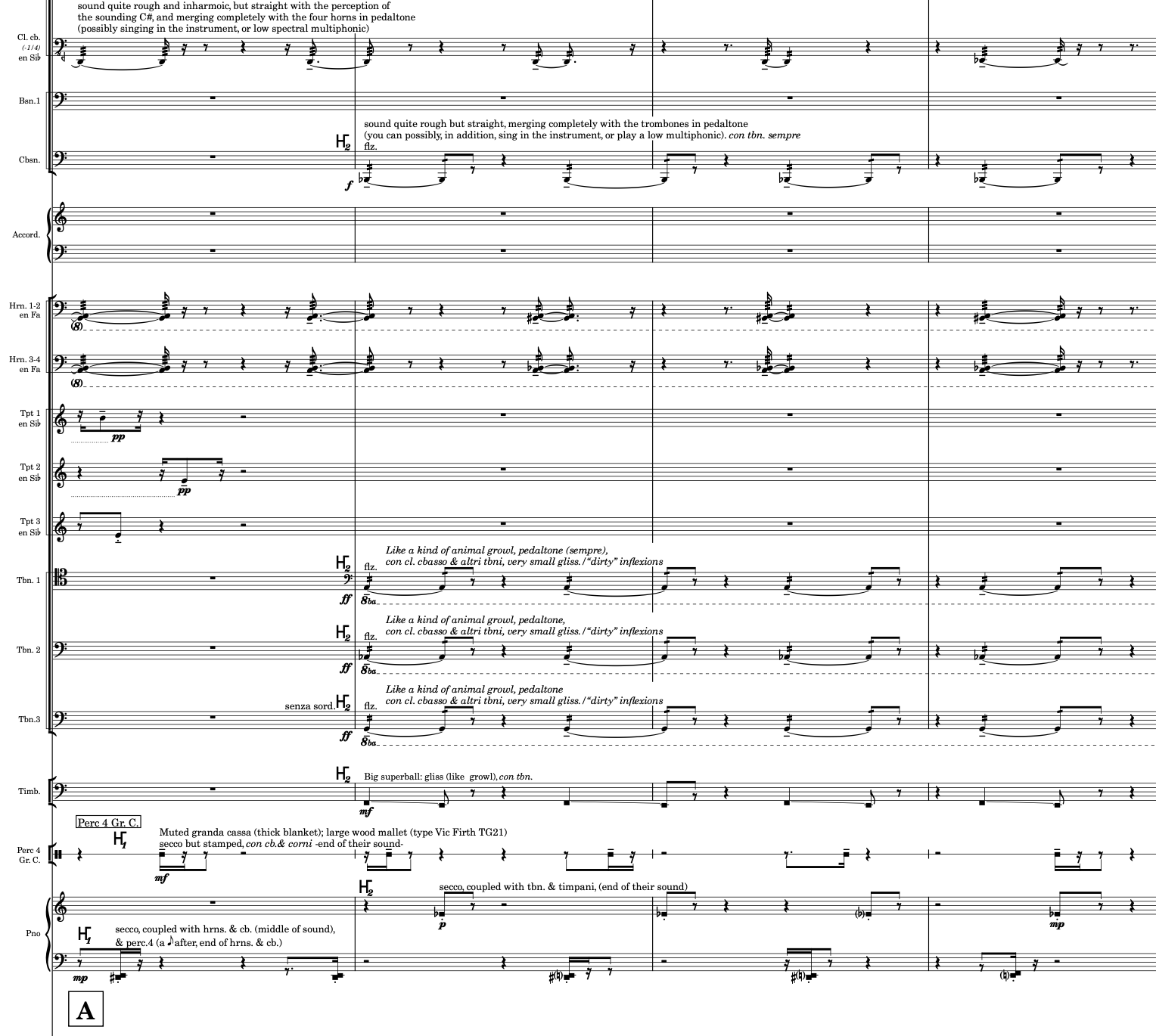
Figure 7. Coupling with regular time offset at A, measures 21–24.
RH
Do these groupings of instruments within each Hauptstimme fit within your concept of the virtual instrument?
FL
Yes. You know that when I wrote my articles on orchestration, I’d already been using that term “virtual instruments” since my first saxophone quartet. So it was not musicological at first. The idea was to go beyond just the notion of coupled and doubled. Virtual instrument means something more general. For example, I have many pieces where I use the term “virtual instrument” to indicate that I have my perceived instruments, but they are not related to any single real one (like in my saxophone quartet, Example 8). Rather, they move from one real instrument to another. So “virtual instrument” means going above the normal instrument, it's more general than just copying or moving notes from one part to another, etc. There are subcategories.
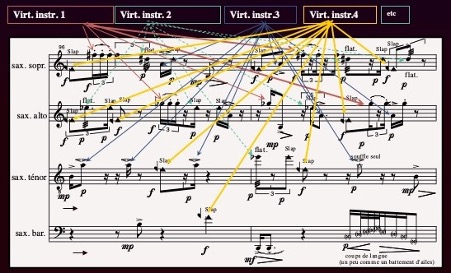
Figure 8. Virtual instruments in Durch, in memoriam Gérard Grisey for saxophone quartet, measures 96–97 (score in C). © Billaudot, 1998.
RH
It’s the idea of creating one virtual instrument out of many parts, many separate real sound sources, right? In a sense, it's another illusory or phantasmagoric kind of orchestrational effect.
FL
Yes. You have two ways to do a virtual instrument. One is to build something up from different instruments. And the second strategy, the second illusionary strategy is to exchange. If I have something here (gestures) and I repeat it over here and over here (gestures), they become virtual.
RH
It seems almost like a kind of Webernian strategy to me.
FL
Perhaps. These are the two strategies for creating virtual instruments: to build up something complex and to exchange—a hoquetus.
Another concept you’ll find in my Oxford Handbook article, directly applied in this orchestral piece: when you orchestrate for a large orchestra, there are two very different ways of approaching the orchestra. One, the most common, is “tutti-like”: that is, treating the instruments as various functions of that large body known as the orchestra—the function of pedals, of “sauces,” of accents, orchestrating a decrescendo or making a microtonal accentuation of the Doppler effect, etc. Another, rarer way of orchestrating—which you can already find in classical music and in Webern—is “chamber music-like,” meaning that, in rare moments and for contrast, you treat the instruments as participants in a large-scale chamber music piece, where they are less “functionalized.”
You can see this on pages 8 and 9, letter D, where I progressively go from a “chamber music-like" to a “tutti-like” orchestration. Here it's textural but still very rhythmical, like a cyclical, small music box, but with exchanges all the time in terms of texture. This is another example of the virtual instrument, achieved through exchange.
Another example of something I discuss in my article: a texture can be in transition. For example, at letter I, we start with something very even and smooth, and the texture gradually becomes “striated” (as Boulez would say), pulsating.
RH
I wanted to ask you about this section at measure 21, actually, because of the colourful instruction given to the trombones: “like a kind of animal growl.” It’s a really fascinating poetic image as well. How do you think of that image of the animal with regard to the whole sound world of the piece and the notion of environmental collapse and extinction?
FL
The idea of an animal didn't come first. First came the sonic idea of a noise, which is very low and very rough. But I was afraid that the instrumentalists would say I can't play this pedal sound, or would try to do something too clean. So they had to be encouraged to be noisy, to imitate an animal. This sort of growling is more important. It's the end of the world, you hear two voices—a counterpoint, it’s textural but in two layers—it builds, coupled, but with different speeds in H1 and H2. So we hear the two voices.
RH
You mentioned Risset, of course, but certain aspects of the continual descent and other paradoxical things also made me think of Grisey’s Vortex Temporum, and I know you were very close to him as well. The detuned clarinet also reminds me of that piece. The other major historical piece I recall working with two groups of instruments a quartertone apart is Ligeti's Ramifications, which has always been described to me as a super challenging piece to play because the detuned group keeps trying to correct its tuning to match the other group. I was wondering if either of these pieces was an inspiration or if there are other influences lurking in the background.
FL
You know, I'm now an old composer [laugh], so I repeat my techniques. The idea of microtonality is completely incorporated. And the idea is to create a huge instrument or small instruments, which don't sound “classical.” That’s why I need such microtonality. But what is different, I think, compared to composers like Grisey (who was my composition teacher at Paris Conservatory), is that I am textural, but I am also rhythmical and metrical, and I think of form as narrative. The concept of rhythm in my music has absolutely nothing to do with the abstract alphabet we call “rhythm” in Western music, but rather with a cognitive framework composed of several levels. I think about the three levels of hierarchy that Simha Arom defined (and came to understand through his encounter with musics other than Western music): the nominal pulse, or better the tactus, the basic level of pulsation that forms the foundation of the grid (our foot tapping); next, the minimal pulse, which is the minimum, fastest pulse at which this tactus can be broken down (sixteenth notes, eighth notes, etc.—it depends); and finally the metrical pulse, which groups the tactus into larger units for counting (a measure of 4/4, etc.). A composer who composes with rhythms transforms one or more of these levels in order to mislead while still retaining another in order to lead the cognition of the listener.
So to lead, you have a clear spectral harmony and/or a regular pulse; and to mislead you can apply a lot of different tools (breaking some of the rhythmical levels of the grid, exchanging and creating virtual instruments, strange orchestrations, etc.). This is why, for instance, at the beginning of the piece, you have a sort of huge texture which is complex and constantly exchanging, but you also have the sixteenth notes which are regular. It's always this dialectic of “lead” and “mislead” that's essential to my music.
And at the end, what I’m seeking with this general cognitive program of leading/misleading is for my listeners to react like children, to ask themselves “Where is it coming from?” You can create these illusions through building the sound, through coupling, but also through exchange, having a line that moves around the ensemble. And that is not influenced by Ligeti or by the spectral school. It really comes from my aesthetic program of misleading, which has involved the creation of a lot of new techniques.
RH
To me, that seems very closely related to the kind of multilayered thinking you find in Hindewhu or African polyphony, I can see why those styles are so appealing to you.
FL
You know, the idea of hoquetus is a philosophy of life, actually. I discovered that when I started to study with Grisey, he said something very interesting that I didn't understand at that time. He said, “Fabien, you compose with a brush with one hair.” And it's true that whatever I do in my life, I like to break it up, to redistribute it, to mislead. Rather than a single line, I’ll scatter it into many fragments that fit together. I always like to deconstruct. It's my personality, it's my complexity, my neurosis, perhaps.
RH
I can see how that deconstructive, fragmentary way of thinking would have been very different from the idea of a traditional viola concerto, as you mentioned earlier. It seems to me like the traditional concerto soloist with a continuous solo line and bravura virtuosity might be almost the opposite of the deconstructed lines you like to create.
FL
Exactly. If you hear my viola concerto, it's exactly about that. You start with the one viola soloist, but its playing implies five different instruments through different gestures, timbres, and registers. So you have one soloist in front doing five different kinds of gestures, then the sounds begin to come from the orchestra, and you never know if it's one or the other. And now I understand that it was always like that in my life, and I don't know why. In Hindewhu Extinction, whenever there is a line that seems clear, it’s always distributed among various tubular flutes or trumpets with different mutes, in hoquetus. Of course, it's related to my interest in the paradoxical, in deconstruction: to always have something which both is and is not, you know.
RH
That’s fascinating, that sums up a lot of the aspects of the piece that we’ve talked about today. That seems to me like a good note to end on. Thanks for all the insightful comments and the guided tour of the piece!
FL
Thank you too for your interest in this piece, and I will let you know how it works!