
Instruments | Resources

“The cymbals look like two giant metal discs which are either rubbed together to make a rustling sound, or stuck together to make a large crash!”
“The xylophone is part of the percussion family, and is composed of a frame which supports wooden bars of varying lengths, generally placed in the same way as a piano keyboard.”

Instrument Studies for Eyes and Ears, by Don Freund, site designed by Reid Merzbacher
Instrument Studies for Eyes and Ears, by Don Freund, site designed by Reid Merzbacher
Instrument Studies for Eyes and Ears, by Don Freund, site designed by Reid Merzbacher
Instrument Studies for Eyes and Ears, by Don Freund, site designed by Reid Merzbacher
“Part of the woodwind family, the bass clarinet has the deepest sound of the clarinet family. The instrument is so big that it must be supported by a floor peg.”
“The bass drum is made of a cylindrical wooden frame called the shell, with two thin sheets of plastic pulled taut across either side to create the drum heads.”
Instrument Studies for Eyes and Ears, by Don Freund, site designed by Reid Merzbacher

“The aim of The Orchestra: A User's Manual is to provide information about the orchestra, orchestration, composition and instruments, for the benefit of anybody with an interest in the subject.”
“Like its cousins the oboe and English horn, the sound of a bassoon is produced by vibrations formed by the player blowing through a double reed fixed to a long, curved metal tube called a bocal, which connects the reed to the body of the instrument.”
Instrument Studies for Eyes and Ears, by Don Freund, site designed by Reid Merzbacher
Instrument Studies for Eyes and Ears, by Don Freund, site designed by Reid Merzbacher
Instrument Studies for Eyes and Ears, by Don Freund, site designed by Reid Merzbacher
“The aim of The Orchestra: A User's Manual is to provide information about the orchestra, orchestration, composition and instruments, for the benefit of anybody with an interest in the subject.”

“Much larger than its smaller cousins, the cello is played while sitting, with the body of the instrument placed between the legs of the player.”
Instrument Studies for Eyes and Ears, by Don Freund, site designed by Reid Merzbacher
“The aim of The Orchestra: A User's Manual is to provide information about the orchestra, orchestration, composition and instruments, for the benefit of anybody with an interest in the subject.”
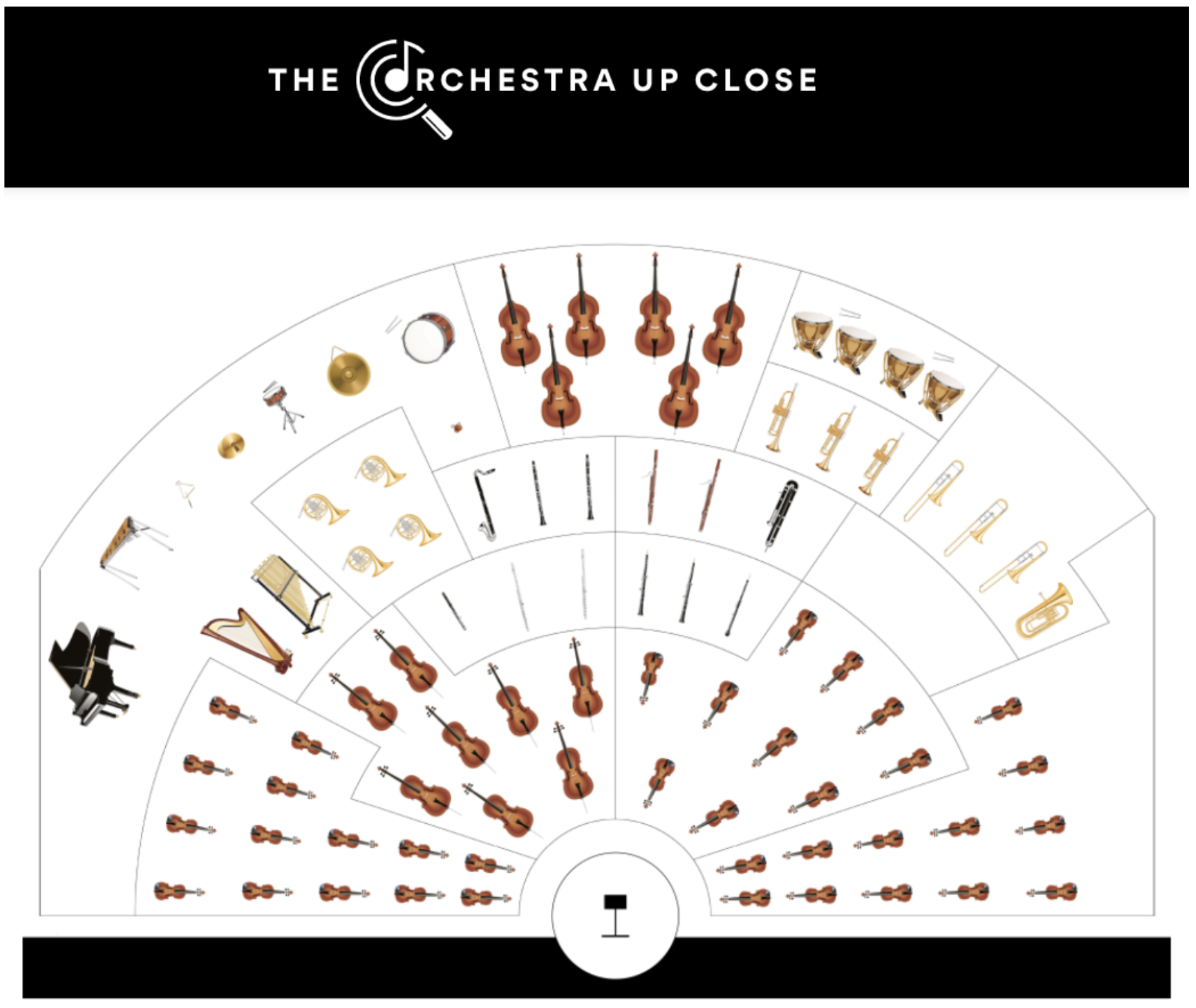
“Like the oboe, the sound is produced with a reed. This time it is a flat, single reed attached to a plastic mouthpiece, into which the player blows, which causes the vibrations to resonate through the instrument, giving it the dynamic range for which it is known.”
Instrument Studies for Eyes and Ears, by Don Freund, site designed by Reid Merzbacher

Instrument Studies for Eyes and Ears, by Don Freund, site designed by Reid Merzbacher

“The double bass, or just bass for short, is the lowest instrument in the string family. Like the cello, the instrument is fixed to the ground with an endpin.”
Instrument Studies for Eyes and Ears, by Don Freund, site designed by Reid Merzbacher
Instrument Studies for Eyes and Ears, by Don Freund, site designed by Reid Merzbacher
Instrument Studies for Eyes and Ears, by Don Freund, site designed by Reid Merzbacher
“The aim of The Orchestra: A User's Manual is to provide information about the orchestra, orchestration, composition and instruments, for the benefit of anybody with an interest in the subject.”
Instrument Studies for Eyes and Ears, by Don Freund, site designed by Reid Merzbacher
“Part of the woodwind family, the English horn is a larger version of the oboe with a pear-shaped bell, usually made of grenadilla wood. There is usually only one in an orchestra and the player sits in the oboe section. The player blows into a double reed which vibrates and resonates into the instrument, producing a sweet and melancholic sound. The range of the English horn is slightly lower than that of the oboe.”
Instrument Studies for Eyes and Ears, by Don Freund, site designed by Reid Merzbacher
Instrument Studies for Eyes and Ears, by Don Freund, site designed by Reid Merzbacher


“In the orchestra the pair of cymbals is used chiefly to stress important musical accents, but it can also be used as a quiet rhythm instrument in the background, together with the bass drum, for example.”
“The term xylophone is derived from two ancient Greek words: xylon (= wood) and phoné (= sound). Technically, every instrument that consists of a row of wood bars of various lengths which are arranged according to pitch and struck with mallets, is a xylophone. ”
“The marimba looks almost exactly the same as the xylophone, but is larger, has a lower register (from bass through tenor to alto) and a wider compass. It is a xylophone with resonators – xylo-phon simply means "wood sounder" – pitched an octave deeper.”

“There are various ingenious ways in which the marimba is designed to produce musical notes, including in places you cannot see, as well as through the length and thickness of the wood.”

“A bass clarinet has a neck instead of a barrel, and the bell of the instrument has a slot for a peg on the back of it. The peg is there to support the weight of the instrument on the ground while player is sitting.”

“As is evident from the name, the bass clarinet is the bass instrument of the clarinet family. It has been used to provide the bass voice in the orchestra woodwind section since the middle of the 19th century, a role it shares with the bassoon. The bass clarinet is appreciated for its expressive timbre, which is often poetically described as ”dark velvet”.“

“The bass drum covers the bass register within the orchestra percussion section, while the tenor drum corresponds to the tenor, the snare drum to the treble register.”
“The bassoon is a woodwind instrument in the tenor and bass register. Like the oboe, the bassoon is a double-reed instrument, because the mouthpiece has two reeds that lie very close together. Unlike the oboe the shawm-like sound that this mouthpiece produces is tempered by the U-shaped bend of its wind duct, so that bassoon notes are not a homogeneous continuation of the lowest notes of the oboe’s compass.”

Fingering charts for the French bassoon.

Fingering charts for the German bassoon.

“This fingering chart includes both basic fingerings and alternatives that are more appropriate in some passages. Some alternate fingerings are designed for fast passages, while others modify the tone, color, or pitch at normal and extreme dynamic levels. The fingerings apply to Heckel-system (German) bassoons. There is a separate alternate fingering chart for Heckel-system contrabassoon.”

“A wooden conical wind instrument, sounded with a double reed, which forms the tenor and bass to the woodwind section. In the modern orchestra, the family exists in two different sizes: the bassoon and the double bassoon or contrabassoon, sounding one octave lower. Built in four joints, its precursor the dulcian was of one-piece construction.”

“David Newman explains the role of the Bassoon and Contrabassoon in film music in comparison to concert music.”
“From deep resounding low notes to sweet melodies, unhindered expression. The long, wide wooden pipe of the bassoon contains much wisdom.”

“With several recordings of each multiphonic and using a couple of different reeds, an attempt was made to note some of the most prominent repeatable frequencies present in these tones. They are much more complex and variable than what is transcribed here and it is precisely their richness and complexity that is what is most appealing about them.”

Student Instrument Guide and Technique Assignment for the bassoon.
“The bass trombone is a slide trombone with two valves that are operated by the left thumb. The valves make it possible to lower the instrument’s pitch from Bb to F or D. The entire chromatic scale only becomes available thanks to the thumb valve (F tuning) and an additional third-valve (D tuning).”
“The celesta was invented at the end of the 19th century after several experiments and immediately found inclusion in the orchestra. It possesses an interesting dual character: the way its sound is produced makes it a percussion instrument (idiophone), but it is played as a keyboard instrument, usually by a pianist. Celesta parts are lively and quick and often require great virtuosity.”

“My intent in creating this project was to provide composers of today with a new resource; a technical yet pragmatic guide to writing with extended techniques on the cello. The cello has a wondrously broad spectrum of sonic possibility, yet must be approached in a different way than other string instruments, owing to its construction, playing orientation, and physical mass.”

“This article is designed as a starting point for cello technique. It includes broad principles that generally hold true. I am particularly interested in those principles that can release tension and help prevent overuse injuries in cellists. I believe these principles can be applied to other instruments and string pedagogy in general.”

“The cello has four strings. Listed in ascending order, they are: C, G, D, A. The C is the thickest and lowest-sounding string. The A is the highest-sounding string and the thinnest.”

“The cello (violoncello) is the tenor and bass instrument of the violin family (violin, viola, cello). In the 19th century the cello advanced along with the violin to become the most important bowed instrument for solo works. In the 20th century cellists began to specialize more, concentrating more on solo, chamber or orchestral playing.”

A youtube channel exploring extended techniques on the cello.

“Cello Map is a practical resource for those who are interested in performing and writing contemporary music for cello.”
“The Clarinet is made up of three parts: the headjoint, body and foot. When connecting the pieces, the hole in the headjoint should line up in a straight line with the row of keys on the body. The main rod on the body of the Clarinet should line up with the middle of the keys on the foot joint.”
“The clarinet is the most recent addition to the woodwind family (flute, oboe, bassoon, clarinet) and was the last woodwind to be integrated into the symphony orchestra (during the period of “Viennese Classicism” in the 2nd half of the 18th century).”

A website covering extended techniques for the Clarinet.